With the rapid development of the animal breeding industry and the complex needs, more and more farmers began to make their own animal feed, but how to choose the most suitable animal feed machine according to their actual needs is a professional and complex problem, the following we will teach you how to choose the most suitable animal feed machine for your breeding needs!
Why choose the right animal feed machine?
1. Homemade animal feed is becoming the trend of animal husbandry.
In recent years, the rising cost of animal feed has prompted the homemade feed to become an important trend in the livestock industry. Take the poultry industry in Nigeria as an example, the cost of feed accounts for about 70% of the total cost of farming. Even with the decline in the prices of raw materials such as maize and soybeans, the price of commercial feeds remains high, prompting farmers to turn to homemade animal feeds to reduce costs and stabilize production. In practice, small and medium-sized farmers have the flexibility to adapt animal feed formulations using local raw materials such as maize, rice bran and cassava by-products. This saves costs and reduces dependence on commercial feed mills, increasing their ability to cope with raw material price fluctuations and supply chain instability.
2. Poor selection of animal feed equipment can lead to wasted costs.
For buyers and users of feed processing machinery, whether animal feed processing machinery can be kept in good running condition will directly affect the quality, yield and comprehensive production cost of animal feed. At the same time, it will also affect the quality of feed and the feeding effect of animals. Whether you operate a poultry farm, a fish farm or a livestock farm, choosing the right high-quality animal feed processing machinery with local after-sales service is critical to long-term success.
Common types of animal feed processing machinery on the market
1. Animal feed milling machine
Feed mills are mainly used to crush raw materials such as corn, soybean meal, straw and other raw materials to the appropriate particle size. Uniform particle size is conducive to animal feeding and digestion, improve feed absorption and utilization.
The principle of animal feed mill is to use the high-speed rotating hammer head to impact, shear and crush the raw materials, and gradually refine them into uniform particles. The screen controls the final particle size to achieve stable and efficient crushing to meet the requirements of subsequent mixing and pelleting processes. Feed mill is usually used in conjunction with cleaning and screening equipment, batching system, mixer and granulator, etc. It is one of the key equipments in animal feed processing line.
2. Animal feed mixer
Animal feed mixer is mainly used to mix various raw materials such as corn meal, soybean meal, vitamins, minerals and liquid additives, etc., to provide stable quality formula feed for subsequent pelleting or direct feeding. Uniform mixing ensures that the nutrient composition of each feed is consistent, thus improving the growth rate of animals and the utilization rate of feed.
The feed mixer usually adopts horizontal U-shaped mixing chamber structure, and is equipped with internal spiral belt or paddle mixer. When the equipment is running, the internal and external mixing blades drive the material to reverse movement, which can realize the rapid and uniform mixing of raw materials in a short time. This equipment can process powder, granule and part of liquid additives, and can be used with crusher, granulator and other equipment to form a complete feed production line, which is widely used in poultry, livestock and aquatic feed production.
3. Animal feed pelletizer
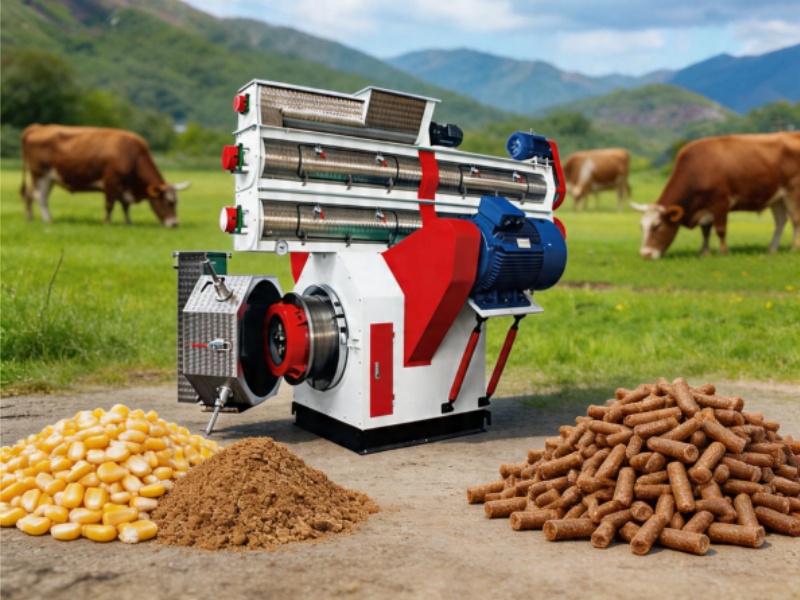
Animal feed pelletizer is an important equipment to make granular feed by mechanically extruding powdery raw materials or grass powder raw materials. Common animal feed pelletizer is mainly divided into two types of ring die pelletizer and flat die pelletizer.
The first is ring die pelletizer.
Ring die pelletizer is a typical large-scale pelletizing equipment, with high output, high efficiency, high degree of automation. They are widely used in medium and large animal feed processing plants as well as production lines of large farms. The equipment is suitable for processing corn, soybean meal, cottonseed meal and other highly viscous concentrated feedstuffs. It is usually equipped with a steam conditioning system to soften and ripen the raw materials so as to improve the quality of pellet molding. The conditioned feed particles have smooth surface, uniform structure and good palatability, which are easier for animals to digest and absorb, and at the same time enhance the market competitiveness of the products. Ring die pelletizer usually needs to be integrated with crusher, mixer, cooler and packaging machine to form a complete animal feed production line, making it more suitable for continuous and large-scale production environment.
The second type is the flat die pelletizer.
Flat die feed pelletizers, often referred to as small feed pelletizers, are mainly for family farms, small livestock farms or primary feed processing users. The equipment adopts the processing method of “dry feeding and dry discharging”, and usually does not need to add extra water in the pelletizing process. It is easy to operate, compact structure, low energy consumption, low investment costs, small footprint, easy maintenance and other advantages.
In addition, the high temperature generated in the pelleting process can effectively kill some of the microorganisms in the raw materials, improve the safety of feed and extend the storage time of the finished pellets. For the production of single raw material or simple formula, flat die pelletizer can meet the demand; but if there are many kinds of raw materials, it can be used in conjunction with crusher and mixer to improve the production efficiency and pellet quality.
4.Complete animal feed production line
A complete animal feed production line is a complete processing system that processes raw materials such as corn, soybean meal, wheat and various additives into pellets or powder compound feed. A standard animal feed production line usually includes key steps such as raw material receiving and cleaning, crushing, mixing, pelletizing, cooling and packaging. Raw materials are first cleaned to remove impurities and then processed to the right particle size using crushing equipment; followed by precise mixing according to the formula ratio to ensure a more even distribution of nutrients; next, they enter the pelleting system to be pressed into pellets to improve palatability and storage stability; and lastly, they are cooled and automatically packaged for easy transportation and marketing. The line is widely used in the production of poultry, livestock and aquatic feeds. The entire line operates through several coordinated processes to achieve continuous, efficient and consistently high quality feed production.
The production line can also be flexibly configured according to different breeding needs and production scales, making it an important basic equipment for achieving large-scale, standardized feed production.
Key factors to consider before choosing an animal feed pelletizer
1. Farm size and production capacity
First of all, according to the size of the farm to determine the required equipment production. Small farms are usually suitable for a flat die pelletizer or a combination of small crushing and mixing equipment; while large commercial farms require a complete automated animal feed production system, as well as conveying and continuous pelleting equipment to meet the needs of high-yield, continuous production. Reasonable matching of production capacity can avoid the problem of insufficient equipment or over-investment.
2. Integration with complete production line
Animal feed pelletizer is not a stand-alone equipment, it should be selected in combination with the whole production process. Ideal production system usually includes raw material cleaning, conditioning, granulation, cooling, screening and crushing. If there is a lack of funds in the early stage, you can first buy granulators and crushing and mixing system, you can communicate with the feed equipment manufacturers to design programs for the later upgrade of the complete feed production line to prepare, equipment to be compatible with each other, the compatibility of the equipment directly affects the overall production efficiency; reasonable planning of upstream and downstream processes can effectively avoid bottlenecks in the production, and improve the stability of the operation.
3. Durability and quality of wear parts
The raw materials in the process of feed processing are highly abrasive, so the quality of key wear parts is particularly important. Components such as ring die, pressure roller, hammer head and screen directly affect the quality of pellets and equipment life. Choosing highly wear-resistant core components reduces maintenance frequency, lowers operating costs and improves production efficiency.
4. Versatility and customization of equipment
Animals at different growth stages have different requirements for feed pellet size and nutritional structure; therefore, animal feed equipment should have a certain degree of flexibility. For example, the equipment should be able to change the mold size, adjust the compression ratio or produce different forms of feed (powder, granules, crushed feed, etc.). In addition, equipment suppliers that support customized configuration and perfect after-sales service are more conducive to long-term stable production.
In general, when choosing animal feed equipment, you should focus on how well it matches the production scale, the synergy of the whole system, the durability of key components and the flexibility of the equipment. A comprehensive evaluation of these factors can effectively improve production efficiency.
How to choose a reliable animal feed machinery manufacturer
Choosing a reliable animal feed machinery manufacturer is crucial to ensuring stable performance of feed machinery and equipment, improving production efficiency and safeguarding investment. When choosing a supplier, you should focus on core factors such as production capacity, technical strength, quality control system, after-sales installation and other service capabilities and experience in feed mill equipment projects to ensure long-term stable operation of the equipment and to meet future expansion needs.
1. Capacity and manufacturing strength of feed machinery manufacturers
High-quality feed machinery manufacturers usually have complete production facilities and advanced processing equipment, such as CNC machine tools and laser cutting equipment, to ensure the accuracy of key components and the stability of equipment operation. At the same time, the supplier should have large-scale production capacity and be able to provide modularized design solutions for feed equipment to meet different production capacity requirements as well as subsequent upgrading and expansion needs.
2. technological innovation and automation level of machinery and equipment
The technical level of feed machinery and equipment directly affects the processing efficiency, energy consumption and nutrient retention rate of animal feed. Reliable manufacturers usually equip their equipment with variable frequency motors, low temperature tempering and pelleting technology, and PLC automatic control systems to realize automatic parameter adjustment, fault alarms and remote monitoring, so as to improve the production efficiency of feed machinery and equipment and reduce labor costs.
3. Quality control system of equipment
A comprehensive quality management system has been implemented throughout the production process, from raw material procurement and parts manufacturing to the assembly and final inspection of the entire feed machinery and equipment. For example, key components are made of high-strength materials and undergo strict quality control.
Long-term full-load operation test ensures the stability of the feed equipment and the quality of granulation, and reduces the risk of production interruption in the later stage.
4. Pre-sale and after-sale service capability
Professional suppliers not only provide feed machines and equipment, but also provide comprehensive pre-sales and after-sales technical support services, including receiving customers to visit the factory, introducing the production process program, production line layout design, testing the machine before shipment, after the arrival of the installation and commissioning guidance and rapid after-sales response mechanism. They also provide machine spare parts supply and regular maintenance services to effectively reduce the equipment failure rate and improve the return on investment.
5. Qualification and project experience
When choosing a feed machinery and equipment manufacturer, it is also crucial to verify the company’s qualifications and project experience, such as ISO certification, CE certification and actual project cases. High-quality suppliers usually have experience in implementing similar-sized projects and can provide customer production cases or on-site visits to verify their delivery capabilities and industry reputation.
In conclusion, selecting a reliable feed machinery manufacturer should focus on evaluating its manufacturing capacity, technology level, quality control system, service support capability and project experience. A systematic comparison of these key factors can effectively reduce procurement risks and ensure the long-term stable and efficient operation of the feed production line.
Recommended animal feed machinery solutions for farms of different sizes
Different sizes of farms have different needs for animal feed machinery, choosing the right animal feed production solutions needs to be based on the size of the farm, the type of animal feed needs and the degree of automation for a comprehensive planning, machinery and equipment configuration and investment intensity, a reasonable production program can improve production efficiency, reduce operating costs, and achieve long-term stable development of the farm.
1. Small farms: basic animal feed processing program
For small farms or self-use production needs, usually choose a combination of simple, low investment in basic feed machinery and equipment, such as grinders, mixers and small granulators. This type of solution can meet the basic feed processing needs and effectively improve the palatability and nutritional uniformity of feed. At the same time, small feed machinery and equipment have a small footprint and are easy to operate, making them suitable for initial investment or family farms.
2. Medium-sized farms: semi-automatic animal feed production system
Medium-sized farms usually need more stable and continuous production capacity, and can be equipped with semi-automatic animal feed production systems, including key components such as mills, mixers, pelletizers and cooling equipment. This type of production solution can ensure the quality of animal feed pellets, improve the stability of feed storage, reduce manual operation, and improve the overall production efficiency.
3. Large farms: fully automated animal feed production lines
Large farms or commercial feed processing plants are more suitable for fully automated animal feed production line solutions. A complete feed production system typically includes raw material grinding, batching and mixing, pelletizing, cooling, conveying and packaging, and is equipped with an automated control system to achieve continuous feed production and efficient operation, while reducing labor costs and improving product consistency.
4. Customized solutions based on feed type and animal species
Different animals have different requirements for feed particle size and nutrient content, so the feed production program should be adjusted according to the type of animal being raised. For example, different growth stages of animals need different feed particle size and nutrient content, poultry, livestock or aquatic feed processing technology and equipment selection is also different, so to communicate in advance the type of feed needed according to the actual needs of their own farms, so that the engineer reasonable allocation of feed machinery, customized for their own farms to feed production program, which can improve the utilization rate of feed and production efficiency.
In conclusion, the animal feed production program should be based on the farm size, automation needs and feed types for a reasonable configuration. From basic equipment combinations to complete automated production lines, choosing the right solution for different sized farms can effectively improve production efficiency, ensure feed quality and get a higher return on investment.
We hope the above information can help you choose the right animal feed production equipment for your own farm needs!